
Canyon Lake Resident Lookup Records
Canyon Lake has no separate city clerk or municipal court in the sources reviewed. A name search therefore starts with Comal County and Texas systems. The Comal Appraisal District eSearch can tie an owner name to a parcel, while the tax search can distinguish an owner mailing address from the property situs. Court and vital sources answer different questions. None is a complete resident roll. A property owner can live elsewhere, and a public case name can belong to a different person with the same name.
| Record source | Identity detail it can support | Custodian or portal | Access boundary |
|---|---|---|---|
| Appraisal parcel and tax account | Current assessed owner, parcel identifiers, and situs, the physical property location | Comal CAD eSearch and county tax search | Public research tools; owner is not every resident |
| Voter registration | Current registration, Voter Unique Identifier (VUID), polling information, and districts | Texas My Voter Portal | Individual lookup; suppression and protected-record rules apply |
| County or district court | Party name, case type, filing and docket events when public | re:SearchTX and Comal Odyssey | Sealed, juvenile, expunged, and confidential records are absent |
| Vital indexes and orders | Names, event dates, county, file number, and family leads | DSHS indexes and the Comal vital portal | An index is not a certified record; eligibility rules apply |
| DBA or licensing record | Public business affiliation or credential status | County Clerk, SOS, and state boards | Affiliation is not proof of residence |
Start with the record that matches the detail in hand. An address usually calls for the appraisal roll; a case number belongs with the clerk; a known birth or death year belongs with DSHS. For an older name, a regional directory or archive may provide the date needed to test a modern record. The useful result is a two-source match, not a long list of loosely similar names.
Note: Record dates and custodian screens can change, so save the source and date used for each identity match.
Canyon Lake Court Name Checks
For a Canyon Lake name check involving a court matter, use the county route first. Comal Odyssey Public Access presents probate, civil/family, criminal, jail, and jail-bond categories with a location selector. The county also directs district-record users to re:SearchTX, where cases, text, hearings, and filings can be narrowed with keyword, party, case, date, and court filters. A case number or defendant name may be the most reliable starting point when one is available.
| Odyssey or re:SearchTX field | How it helps verify a name |
|---|---|
| Record type and location | Separates probate, civil/family, criminal, jail, or jail-bond routes before a name search. |
| Party, keyword, or case number | Provides the search anchor and permits name-variant checking. |
| Date and court filters | Help separate older filings from a same-name record in another court. |
| Cases, text, hearings, and filings tabs | Support distinct searches in re:SearchTX, subject to participating-court coverage. |
A docket is the court’s running list of events in one case. It can show a case number, style, case type, filing date, court, events, disposition, and sometimes a linked filing image. The research did not obtain a live Comal docket result, so the exact result-screen fields and historical cutoff remain unconfirmed. Treat a docket as a lead. Compare public address, spouse, attorney, age, or dated property context before deciding it belongs to the Canyon Lake person being checked.
The re:SearchTX search screen is the statewide route for participating courts, while the county clerk remains the source for specific documents or certified copies.
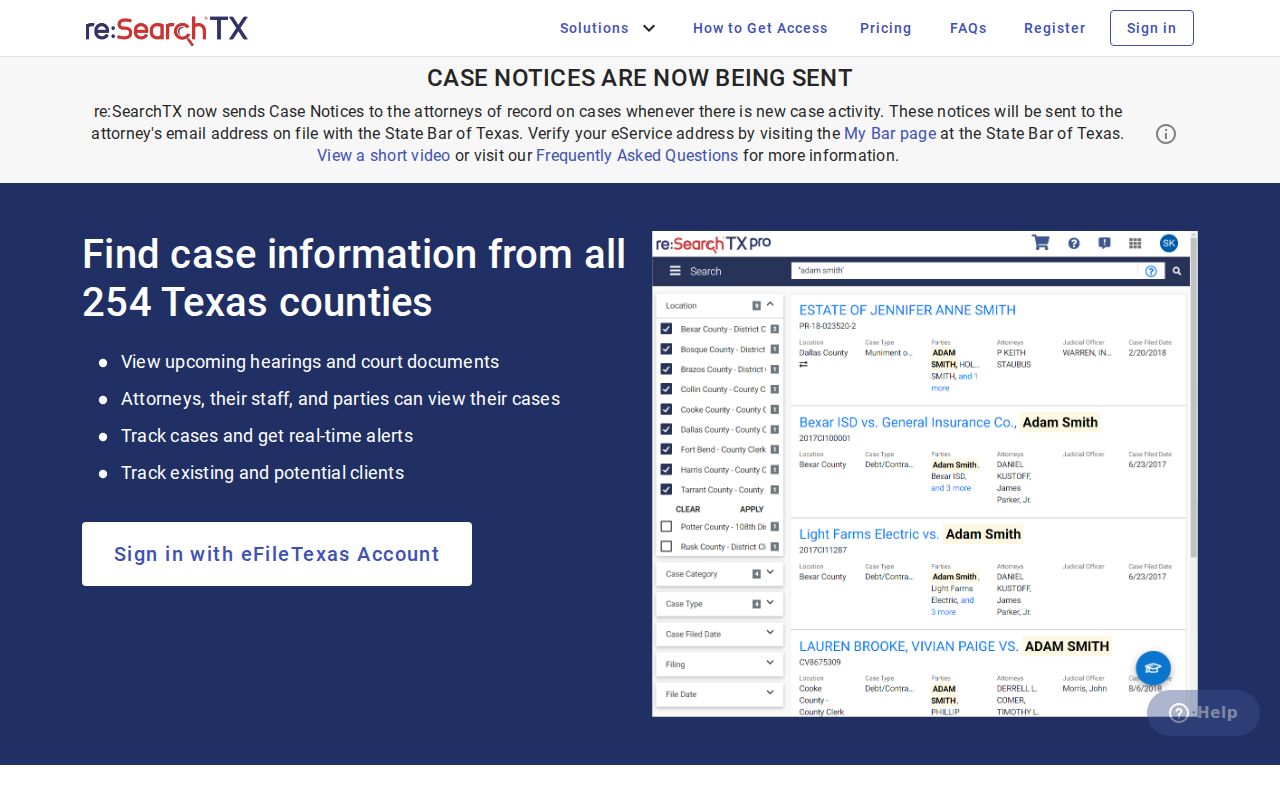
The court interface helps separate cases, filings, hearings, and text searches, but it does not resolve a same-name match by itself. Some clerk transactions or document requests may require an account, payment, or a direct request.
Canyon Lake Voter Registration Match
Texas My Voter Portal is an individual registration tool, not a historical directory. Its documented workflow uses name, county, date of birth, ZIP code, or VUID to narrow a match and can return registration status, polling-place information, districts, and the VUID. Select Comal County when the known address is in the Canyon Lake service area. A result can support a current registration check, but it should not be used to infer ballot choices or a permanent political affiliation.
Texas Election Code rules divide what is public from what must stay protected. The state says all voters may request web suppression, while protected-voter and Address Confidentiality Program participants receive stronger handling. Personal identifiers, telephone restrictions, and protected residences do not belong in a personal name search. A name failure may be a spelling issue, a move, a suppression setting, or simply the wrong person.
For a lawful Chapter 18 list request, contact the voter registrar or SOS and identify the statutory list, delivery format, date or precinct scope, and purpose. The research did not locate a current Comal fee, file format, or historical poll-book inventory. Do not turn an individual portal result into a block roster.
Verify a Canyon Lake Resident
A careful identity check tests a name against separate records that answer different questions. Begin with a full name and a Canyon Lake or Comal County connection, then compare at least two independent details. Useful public details can include a dated address, spouse or relative, property legal description, business affiliation, or court style. Search both the normal spelling and a middle initial, maiden or married name, anglicized spelling, and a last-name-first format where the portal supports it.
- Search the appraisal roll using the owner-name format shown by CAD, then record the parcel identifier, situs, and separate mailing field.
- Check an individual voter result only to confirm current registration when the lawful matching details align.
- Run a party or case search in Odyssey or re:SearchTX with the name variants, then compare public case context rather than relying on the name alone.
- Use a vital index or an eligible certified-copy request only when an event, family connection, or legal need calls for it.
- Docket
- A court’s running list of filings, hearings, events, and outcomes for one case.
- Index versus image
- An index points to a record. An image is the underlying scanned document, which may be unavailable or request-only.
- Certified copy
- A copy issued and authenticated by the official custodian for the purpose that requires certification.
When a person is tied to an earlier address, regional historical material may be more useful than current systems. The dated New Braunfels-Canyon Lake volumes and county indexes are discussed on the Canyon Lake City Directory page. They can help establish an old address before a property or probate record is checked.
Note: A matching name is only a starting point; agreement among independent public records is the safer identity test.
Canyon Lake Vital Index Paths
Texas vital sources serve several distinct jobs. DSHS digital birth indexes begin in 1925 and death indexes in 1965, with earlier material available on microfiche. Marriage indexes begin in 1966 and divorce indexes in 1968. Index fields can provide names, dates, county, and file-number leads, yet they are not legal documents. Under Texas Government Code Section 552.115, birth records generally become public after 75 years and death records after 25 years.
The Comal vital order portal routes eligible certified birth, death, and marriage orders and asks for record selection, applicant and subject information, eligibility documentation, identification uploads, and delivery choices. It states that local birth records reach back to 1906 for Comal and surrounding areas, while local death orders are limited to deaths within the county. DSHS qualified-person rules govern restricted copies. A marriage or divorce verification from DSHS is different from a certified county or district-court record.
The Comal certified-record order screen is pictured here. It makes the record selector, identification, delivery, and payment boundary visible before an order is started.
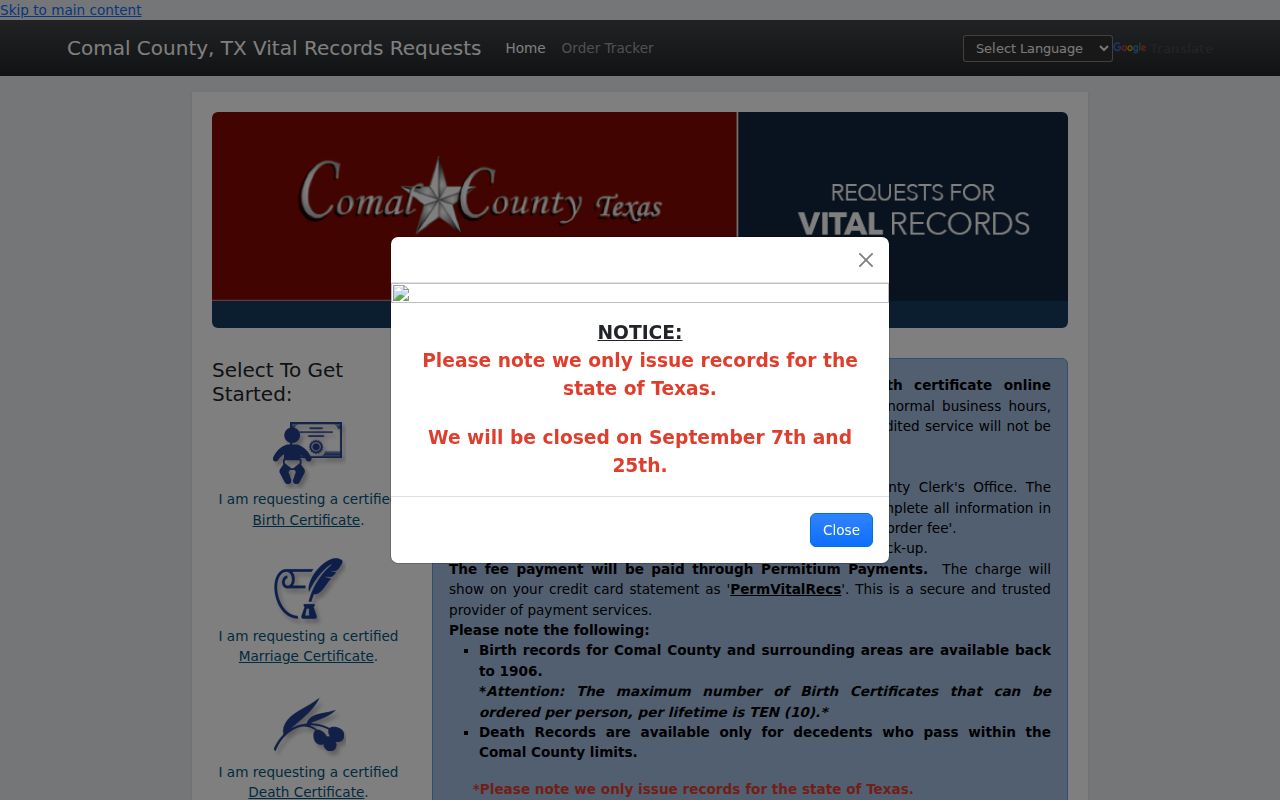
The order route does not make every certificate open. An index may support family-history research, while the custodian decides whether an applicant qualifies for a certified record.
Canyon Lake Probate and Heirs
Probate can be a focused route for an heir search because public filings may identify a decedent, executor, attorney, heirship statement, notice address, or related deed transfer. Begin with a known decedent and case number if possible, then search the probate category in Odyssey or the relevant district route. Some filings can be restricted, and account numbers or other sensitive details should not be reproduced. A probate notice can connect generations without proving a current address for a living relative.
For an adopted person or birth-parent question, use Texas authorized adoption, confidential-intermediary, or registry channels instead of guessing from an online name. Adoption records are confidential, and an unverified name is not proof. For a former classmate, dated yearbooks, local newspapers, alumni material, and library or archive collections provide a better time-specific trail. The Comal County Genealogy Society index and Sophienburg collections can help locate county-level marriage, probate, census, cemetery, church, and obituary material.
Canyon Lake Record Gaps
Several useful Canyon Lake systems have a known inspection limit. The research captured court search categories and re:SearchTX filters, but not a live Comal docket row or a stated historical index cutoff. CAD exposes its search fields and daily-update notice, but the dynamic parcel-card fields were not text-captured. A missing online result is not proof that no record exists, and an unstated cutoff should never be converted into an assumed date range.
Keep the known spelling, address, case number, document number, volume and page, or parcel identifier, then use the clerk, district records office, or a written request for the exact existing record. Canyon Lake’s lack of an incorporated city office makes that county-first fallback especially important. The public record trail may be incomplete, but the reason for a gap should be documented rather than filled with a guess.
Canyon Lake Resident Lookup Limits
Texas public access has firm edges. Sealed, expunged, juvenile, adoption, and confidential court materials may be unavailable. The Address Confidentiality Program can provide an eligible participant a substitute address, and protected-voter rules can limit address visibility. DMV personal information is restricted under the federal Driver’s Privacy Protection Act. Utility and delivery customer information is not a public lookup. A parcel record also cannot establish every person who occupies a property.
| Official source | Best use | Compiled commercial result | Reason to verify |
|---|---|---|---|
| Custodian index, record, or request | Answer one defined question with a dated source | May combine public, marketing, purchased, and inferred data | Names and addresses can be stale or merged |
| Clerk or agency correction route | Ask about the actual record or redaction process | May repeat information from another source | Opt-out or correction steps may need repeat checks |
Lawful use. Use Canyon Lake record sources for personal, lawful research, family history, estate questions, or verifying a specific public record. Never use record information to stalk, harass, threaten, or intimidate anyone.
Canyon Lake Requests and Corrections
When an online index ends, ask the record holder for an existing, identifiable document. The Texas Public Information Act, Texas Government Code Chapter 552, generally requires a written request for records held by the governmental body. It does not require a clerk to answer a research question, create a record, or perform legal research. The Comal County request-routing page helps direct a request to the office that keeps the record.
For County Clerk research, the published form asks for specific document information such as a document number or volume and page, delivery method, and whether certification is needed. The form states one to three documents may take up to 24 hours and more than three may take up to 48 hours. Certified copies are not emailed. If an agency record is wrong, request its correction or redaction procedure instead of asking staff to confirm private facts by telephone.
Note: A written request is strongest when it identifies an existing record, custodian, and exact document or case reference.